
How a Free Web Tuner Earned Savior Guitar 1,400 Clicks, AI Citations, and the Case for a Pro App
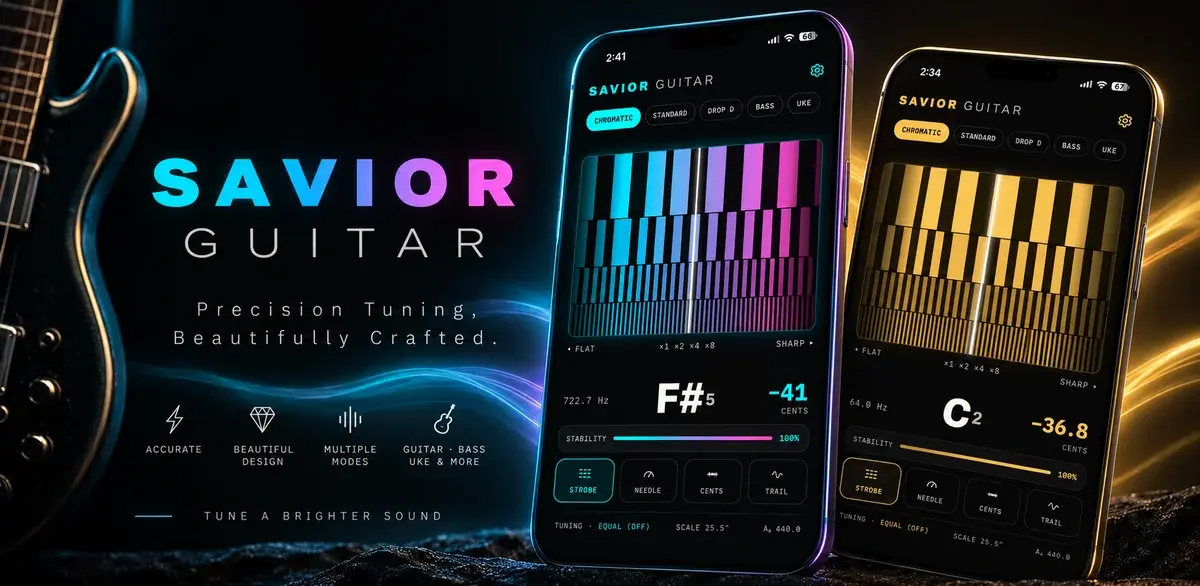
Aron Robbins tunes guitars for a living. Not in the casual sense. On the road, his job is keeping instruments stage-ready for the players behind Bruno Mars, Maxwell, Justin Bieber, Mary J. Blige, and D'Angelo. Right now he's out with J. Cole's Fall-Off Tour.
On his bench in Goldsboro, NC, he tunes with a strobe tuner. It reads to a tenth of a cent. Most of us tune with a free phone app that rounds to a cent or two and turns green when it's close enough.
You know the sound that produces. Six strings, each a hair off in a different direction, stacked into a chord that's almost right. Slightly sour. A little chorused. Most players blame the guitar.
Last spring we asked Aron a simple question: what if the tuner on your bench could live in anyone's browser?
This is the story of what happened next, and why we built the free version first.
Where This Started
When we first helped Savior Guitar get online, the goal was local: a website and a Google Business Profile so musicians around Goldsboro and Wayne County could find a guitar tech with twenty years at the bench. That worked, and it's still working.
But Aron's expertise doesn't stop at the county line. He has kept instruments stage-ready for Jamareo Artis (bassist for Bruno Mars), Derrick Hodge (bassist and music director for Robert Glasper and Maxwell), Isaiah Sharkey (guitarist for D'Angelo, who has toured with John Mayer), Hod David (guitarist for Maxwell), Julian Michael (guitarist for Justin Bieber), Kenneth "Kaybass" Diggs II (music director for Keyshia Cole), and BJ Barham of American Aquarium. You can read the full list on his about page.
That's a lot of hard-won knowledge about how a guitar should actually sit in tune, and it lived in exactly one place: Aron's hands.
We wanted to give current musicians and aspiring ones the same level of access to expert tuning that the pros get backstage. A companion to the bench, not a replacement for it.
Step One: A Free Tuner in the Browser
In late May 2026 we shipped the first version of the Savior Guitar web tuner. No download. No signup. No account. Grant microphone access and tune.
Under the hood it runs the YIN pitch-detection algorithm with parabolic interpolation, the same approach used in serious tuning software. Over the summer it grew into a strobe display, a needle, a cents readout, and a scrolling trail that lets you watch a note settle. Per-string offsets for acoustic, electric, 12-string, and bass, the way a tech dials them in so chords ring true up the neck, not only on the open strings. A4 calibration from 432 to 446 Hz.
Then came the part most people skip.
Instead of one tuner page, we built one page for each tuning people actually search for: drop D, half step down, drop C, D standard, standard, bass, ukulele, and chromatic. Each page tells you what the tuning is for, which strings go where, and answers the questions a player would ask before they trust it. A hub page ties them together. Structured data, an llms.txt file, and short blog posts from the bench sit underneath.
Think about what that means in practice. Someone searching "drop C tuner" at 11pm in a basement rehearsal room doesn't want a general tuner page. They want drop C, right now, and a sentence or two that proves the person who built it knows what drop C is for.
What Search Did With It
Here's the Google Search Console chart for the tuner pages from early July through the start of October.
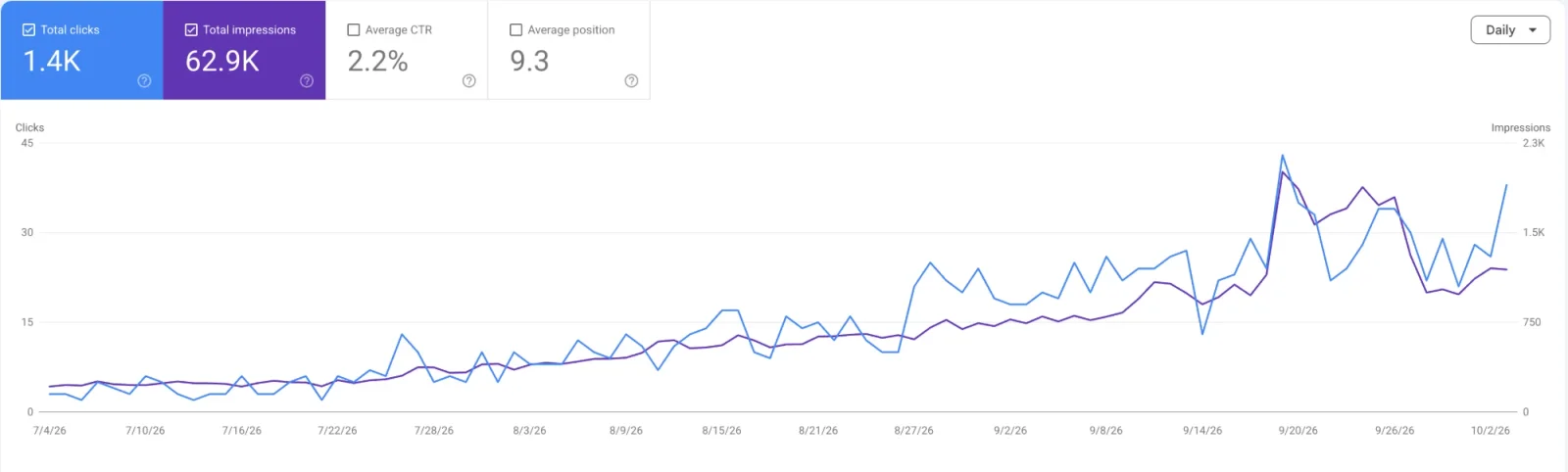
Over that 90-day window: 1,400 clicks, 62,900 impressions, and an average position of 9.3, which puts the pages on the first page of Google for the tunings they target. In early July the tuners were getting around five clicks a day. By late September it was thirty or more, with a few days above forty.
Look at the shape of that line. It isn't a spike. It's a staircase. Each time we added a tuning page or tightened the content on an existing one, the floor moved up and stayed there. Nothing went viral. The pages kept showing up for people who were already searching.
That's what SEO looks like when it's doing its job. Steady, compounding, and tied to real intent.
Then AI Search Showed Up
Something else happened that we didn't have to do extra work for. The same pages began appearing in answers from ChatGPT and other AI assistants when people asked about guitar tuners and specific tunings.
That wasn't luck. AI assistants cite pages that answer one question clearly, in plain language, from a source with real credentials. One page per tuning, a short FAQ on each, a touring tech's name on the byline, and an llms.txt file telling the models what the site is about. The same choices that earned the Google rankings earned the AI citations.
If you're building anything right now, that's worth writing down. The work you do to be found by Google and the work you do to be cited by AI are mostly the same work.
Step Two: The Pro App
By September we had a few months of proof. Sustained, growing demand for this specific tuner, from people who found it on their own. SO. We took it to the next level.
We pulled the tuning engine out into a shared package, wrapped it in a native shell, and on September 16, 2026 Savior Guitar Tuner: Pro launched on the App Store and Google Play.
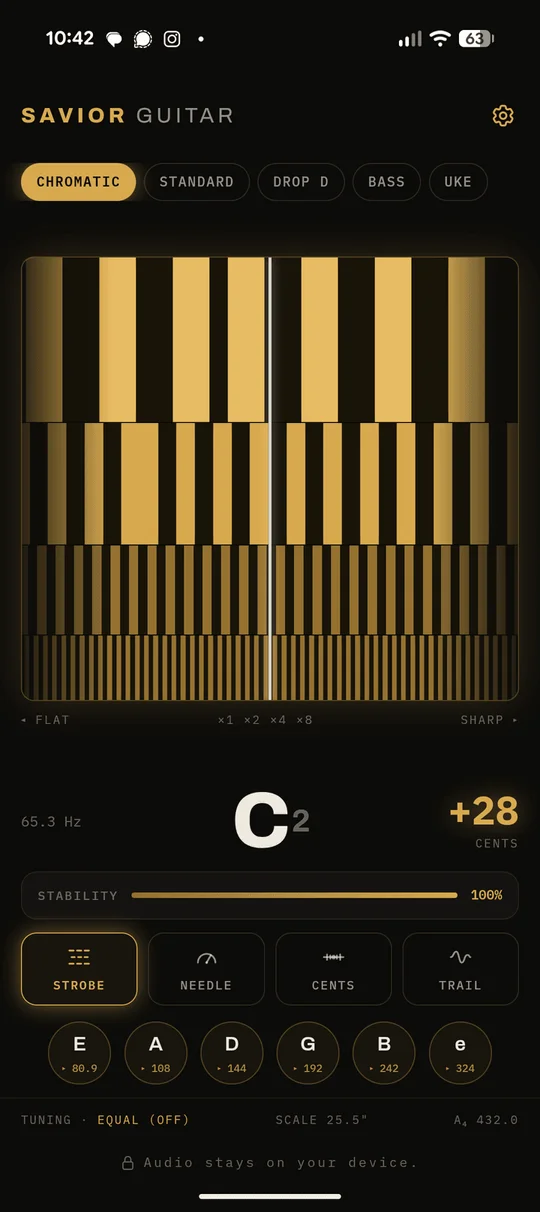
It's built on the same expert-level tuning professional musicians use every night. Strobe accuracy to 0.1 cent, ten times finer than a typical needle tuner. Four displays. Every tuning from the web version, plus the per-string offsets and A4 calibration a tech would set. And the things a browser can't do well: it works completely offline, opens straight into listening with no permission prompts, keeps the screen awake on a dark stage, filters noise in a loud room, and gives a little haptic tap when a string locks in.
No ads. No subscription. No account. One price, $7.99 at launch. And nothing leaves the phone, because the mic listens for pitch and that's all it does.
The free web tuners stayed free. They're the front door. The app is for when you're off the browser and on a stage.
Why the Order Mattered
We could have started with the app. Plenty of people do. They spend months building for two app stores, launch to silence, and then try to figure out who wanted it.
Building the free web version first gave us three things an app alone never would have:
- Proof of demand before the big build. Real people, real searches, a line going up for months.
- A search presence that feeds the app. Every tuning page now points to the Pro app. The audience was already there when launch day came.
- Credibility that compounds. Google and AI assistants learned who Aron is and what his site is about. The app inherited that trust instead of starting from zero.
There's nothing wrong with dreaming about the app store. But the app isn't the first step. The first step is finding out whether anyone is looking for what you know.
What We Believe About Work Like This
We were honored to help take Aron and Savior Guitar's web presence to the next level. First a website for a tech with no online presence. Then a free tool that put his bench knowledge in front of tens of thousands of players. Now an app in both stores. Step by step, each one proving the next.
That's the kind of work we love. Helping the people who help musicians give their guitars what they deserve.
Your Next Step
You have expertise too. Something you know so well that you've stopped noticing it's rare. What would it look like to put one piece of it where people are already searching?
Pick one thing. One question your customers ask you every week. Build the plainest, most helpful page you can about it, and watch what search does with it over the next ninety days.
If you'd like help finding out what people are already searching for in your corner of the world, our Website & SEO Audit is where we start. And if you have a tool or an idea that deserves to be built, let's talk.

About the Author
Jon Horton is the founder of NewCulture. With 20+ years in technology and digital strategy, he helps businesses, nonprofits, and churches build their online presence and reach more people.
Keep Reading
More from the Blog
Best Church Website Design Companies in 2026: 12 Firms Compared on Price, Timeline, and Who Owns the Site
The best church website design companies aren't the ones with the flashiest portfolio. They're the ones that tell you the price, the timeline, and whether you'll own the site before you sign anything. Here's an honest, fact-checked comparison of twelve firms, ours included.

The Real Church Website Cost Over Five Years (Builder, Platform, Custom, and the Volunteer Nobody Counts)
What does a church website cost over five years, once you count the subscription, the setup, the hours somebody spends updating it, and the redesign you'll do at least once? Here's the honest model, built on real published prices, not just the monthly number your finance committee sees.
Why Your Website Builder Can't Tell You Where Your Leads Came From (And What Conversion Tracking Actually Requires)
Most website builders can tell you how many people visited your site, but website builder conversion tracking, tracing a lead back to the ad or page that actually produced it, usually isn't included. Here's what's documented on Wix, Squarespace, Tithe.ly, and Subsplash, and what real conversion tracking requires.