
How to Get Your Business to Show Up on Google Maps (and Land in the Top 3)
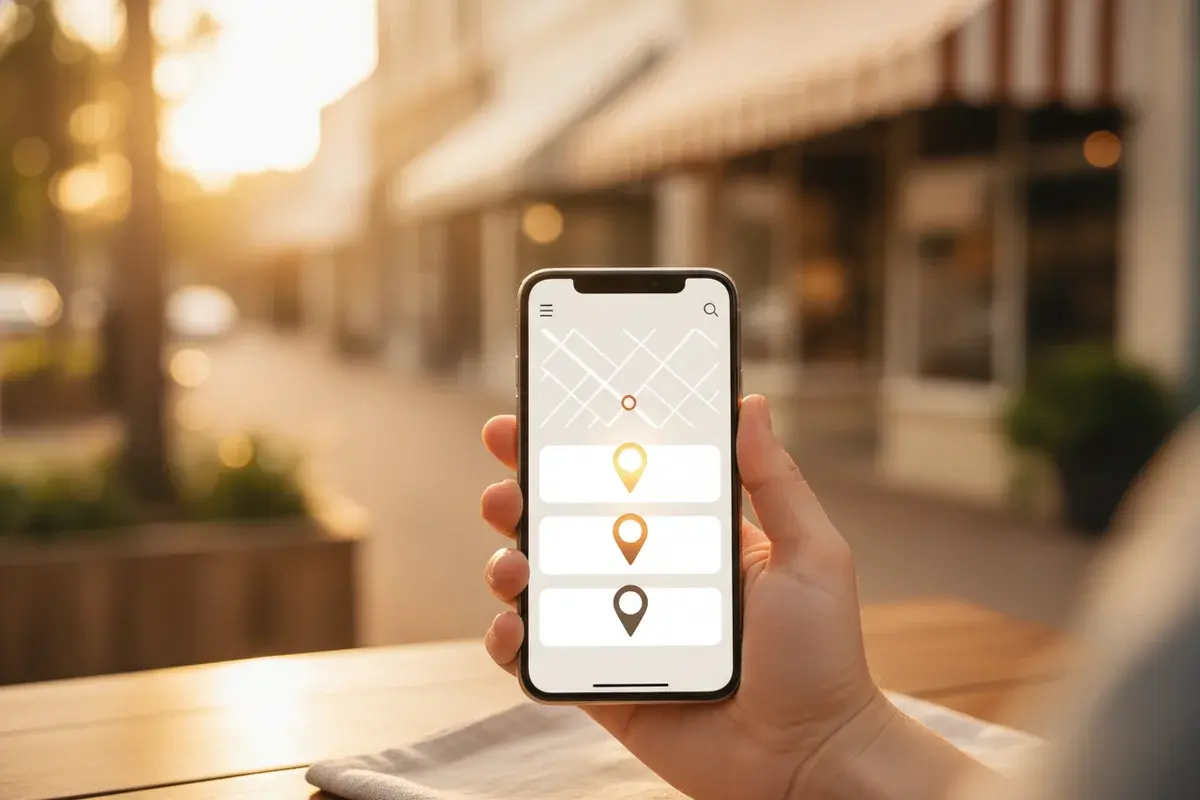
A business owner I talked with was proud of his website. He'd paid for it, it looked good, and when he searched his own business name, there it was. He was on Google.
And he still couldn't figure out why the phone wasn't ringing.
So we did something simple. Instead of searching his business name, we searched what his customers actually type—"insurance agents near me." And there, at the top of the results, sat a little map with three businesses pinned to it. Three competitors. Phone numbers, directions, reviews, the word "Open" in green. Everything a ready-to-buy customer needs.
His agency wasn't one of the three. You had to scroll past all of it to find him.
That little map is called the Google Map Pack—sometimes the "local 3-pack"—and for a local business it is the most valuable real estate on the entire internet. Here's the hard truth most owners never hear: being on Google and being found on Google are not the same thing. You can have a beautiful site, rank for your own name, and still lose nearly every new customer to the three businesses sitting in that box above you.
So let's talk about how those three get chosen—and how you become one of them.
Why the Map Pack Wins Before the Race Starts
When someone searches "coffee near me" or "plumber in [your town]," Google puts the map pack at the very top—above the regular blue-link results, above almost everything. Most people never scroll past it. Why would they? It hands them three open, nearby, well-reviewed options with a tap-to-call button right there.
Think about what that means in practice. If you're the best insurance agent in town but you're sitting in the regular results below the map, you're not competing with the other agents. You're competing with a customer's patience—and patience runs out at the bottom of that little map.
The map pack isn't where local search happens to start. For most "near me" and "in [town]" searches, it's where local search ends.
How Google Decides the Three
Google has said, in plain terms, that local ranking comes down to three things: relevance, distance, and prominence. That's the whole game. Everything you'll ever do for local SEO is really just feeding one of those three.
Let me walk you through each—and what it actually means for your Monday morning.
1. Relevance—Does Google Understand What You Do?
Relevance is how well your business matches what someone searched. And it lives almost entirely in your Google Business Profile—the free listing that powers your spot in the map.
Most businesses fill it out halfway and move on. That's the gap.
To Google, a half-finished profile is a half-understood business. If your primary category is vague, if your services aren't listed, if there's no description and no hours, Google has to guess what you do—and it would rather show a competitor it understands than guess wrong on you.
What to do: Claim and verify your profile if you haven't. Then complete everything—primary category (be specific: "Italian restaurant," not just "restaurant"), every relevant service, real hours, real photos, a clear description. Pick the category that matches what you most want to be found for. Accuracy here isn't paperwork. It's how Google learns to put you in the right searches.
2. Distance—How Close Are You to the Searcher?
This is the one you can't fully control, and it trips people up. Google factors in how close your business is to the person searching, or to the place they named. Someone searching "barber near me" downtown will see different results than someone searching from across town.
You can't move your building. But you're not powerless either.
What to do: Make sure your address is exact and consistent everywhere it appears. If you serve customers at their location instead of yours—a plumber, a cleaner, a mobile mechanic—set up your profile as a service-area business and define the areas you actually cover. Reinforce your location naturally on your website too: the town you're in, the neighborhoods you serve, real local references. You're not gaming distance. You're making sure Google places you where you actually are.
3. Prominence—How Well-Known and Trusted Are You?
This is the one most small businesses ignore, and it's often the tiebreaker. Prominence is Google's read on how established and trusted you are—and the single loudest signal is your reviews.
Not just the star rating. The number of reviews, how recent they are, and whether you respond to them. A business with sixty recent four-and-five-star reviews and thoughtful replies looks alive and trusted. A business with four reviews from two years ago looks like it might not even be open.
What to do: Ask. Genuinely, consistently, every happy customer. Most people are glad to leave a review—they just never get asked. Send the link. Make it a habit, not a campaign. Respond to every review, the good and the hard ones, like a real person. And get your name and details listed accurately on the directories that matter for your industry—consistency across the web tells Google you're the real thing.
The Mistakes That Quietly Keep You Out
Most businesses that aren't in the map pack are losing on the same handful of things—and almost all of them are fixable:
- An unclaimed or unverified Google Business Profile
- The wrong primary category, or a vague one
- A business name stuffed with keywords (against the rules, and it can get you suspended)
- Your name, address, and phone number listed differently across the web
- Few reviews, old reviews, or reviews you never respond to
- A profile you set up once and never touched again
None of these is dramatic. That's exactly why they go unnoticed for years while the phone stays quiet.
Find Out Where You Actually Stand
Here's a test you can run in two minutes. Open your phone—not your laptop—and turn on incognito or private mode so you're not getting your own personalized results. Then search the way a customer would: your service plus "near me," or your service plus your town.
Now ask yourself, honestly: Are you in the three? If not, who is? And what does their profile have that yours doesn't—more reviews, a sharper category, better photos, recent activity?
Whatever the answer, it's information. Wherever the gap is, that's where your next customer is going right now instead of to you.
This is exactly the kind of thing we found when we helped Savior Guitar go from no presence at all to ranking in local search in under a week—not with anything fancy, just the right pieces set up right, in the right order. Local ranking almost always comes down to a short list of specific, fixable things. The trouble is knowing which ones, and which to do first.
That's what our Website & SEO Audit is built for. We look at your profile, your site, and your local presence the way Google does, and hand you a clear, prioritized plan—what to fix first to climb into that map pack, in plain language, no rebuild required.
Your One Step
You don't have to fix all of this today. You have to find out where you stand.
So do the two-minute test. Search your service plus "near me" on your phone, in incognito, and see whether you're in the three. If you're not, look at who is—and pick the one gap that's most obviously costing you. Maybe it's a profile you never finished. Maybe it's reviews you never asked for.
Fix that one thing this week. Then the next.
The customers searching for what you do are already out there, already searching, already choosing—right now, today. The only question is whether they can find you when they do. Reach out if you'd like help knowing which fix matters most.
Tagged

About the Author
Jon Horton is the founder of NewCulture. With 20+ years in technology and digital strategy, he helps businesses, nonprofits, and churches build their online presence and reach more people.
Keep Reading
More from the Blog

Why Your Website Builder Can't Tell You Where Your Leads Came From (And What Conversion Tracking Actually Requires)
Most website builders can tell you how many people visited your site, but website builder conversion tracking, tracing a lead back to the ad or page that actually produced it, usually isn't included. Here's what's documented on Wix, Squarespace, Tithe.ly, and Subsplash, and what real conversion tracking requires.

Does Your Church Own Its Website? What You Keep, What You Rent, and How to Check
Does your church own its website, or just get to use it while the bills stay current? Here's how to check the domain, the content, and the platform separately, so you know what you'd actually keep if you ever had to leave.

Best Church Website Builders in 2026: Tithe.ly, Subsplash, Nucleus, Wix, Squarespace and Custom, Compared Honestly
There's no single winner among the best church website builders, but there is a right one for your church. Here's an honest, fact-checked comparison of ten platforms, including our own custom builds, organized by the three things that actually decide it.